Edge Banding Machines: A Complete Guide for Furniture and Kitchen Factories Before You Buy
The edge is the first thing a customer notices on a kitchen or wardrobe. This guide explains how to choose the right edge bander for your factory and how to get a tight, clean edge.

In this article
- 1.How does an edge banding machine work?
- 2.Types of edge banding
- 3.The specifications to watch
- 4.Common banding defects and their causes
- 5.Prepare your workshop before the machine arrives
- 6.The banding stages in an automatic machine
- 7.Glue types: EVA or PUR?
- 8.Kitchens and humidity in Saudi Arabia
- 9.How many panels can you band a day?
- 10.Daily care for the edge bander
- 11.FAQ
In furniture and kitchen factories, the edge reveals the quality of the work. An edge with gaps, excess or a different colour lowers the value of the piece however beautiful the design. In kitchens in particular, a tight edge is what keeps water away from particle board.
An edge banding machine turns this work from a manual job into a repeatable automatic process at the same quality. In this guide we explain how the machine works, the specifications that matter, and how to avoid common defects.
How does an edge banding machine work?
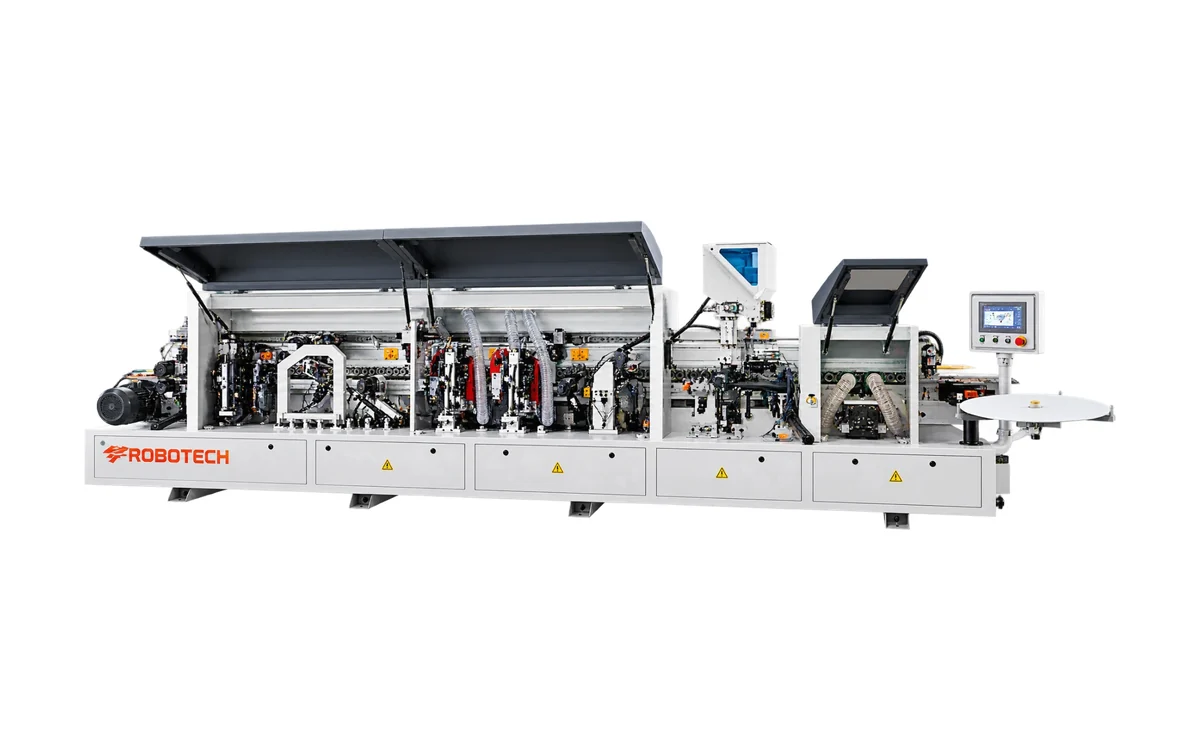
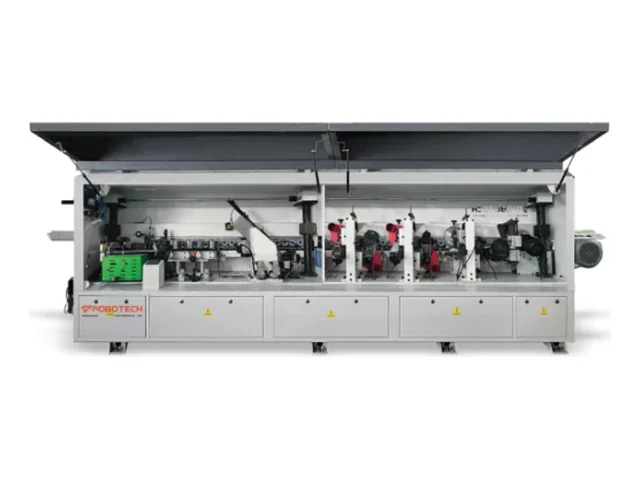
A straight edge bander is a continuous-feed machine: you put the panel on the conveyor on one side and it comes out the other side with a finished edge. On the way it passes through several stages:
- Feeding: the conveyor pulls the panel and sensors detect its start.
- Gluing: a unit applies an even layer of hot-melt glue to the panel edge, at a digitally controlled temperature.
- Pressing: pressure rollers press the edging onto the edge firmly so it bonds without bubbles.
- End trimming: cutters trim the excess edging at the start and end of the panel.
- Trimming: rotating knives trim the excess from top and bottom, flat or radiused.
- Scraping (depending on the model): removes knife marks from the radiused edge.
- Buffing: cloth wheels polish the edge and remove glue residue.
Types of edge banding
| Type | Advantages | Common use |
|---|---|---|
| PVC | Durable, resists impact and moisture, many colours that match panels | Kitchens, wardrobes and office furniture |
| Melamine | Economical and light | Budget furniture and interior parts |
| Wood veneer | Natural wood look | Premium furniture and veneered panels |
| Solid wood strips | Thicker and stronger, withstand impact | Tables, doors and heavily used surfaces |
A machine that accepts a wide range of edging thicknesses (for example 0.4 to 3 mm) gives you the flexibility to work with all these types without a second machine.
The specifications to watch
- Panel thickness: the thinnest and thickest panels the machine accepts; make sure they cover your panels (e.g. 10 to 45 mm).
- Edging thickness: decides which edging types you can use.
- Minimum part width and length: important if you have small parts such as drawers and narrow shelves.
- Feed speed: the higher it is (e.g. 13 to 20 m/min), the higher your daily output.
- Number of stages: scraping and buffing raise the quality of the final edge.
- Power and air: total power and whether the machine needs 3-phase power and a given air pressure.
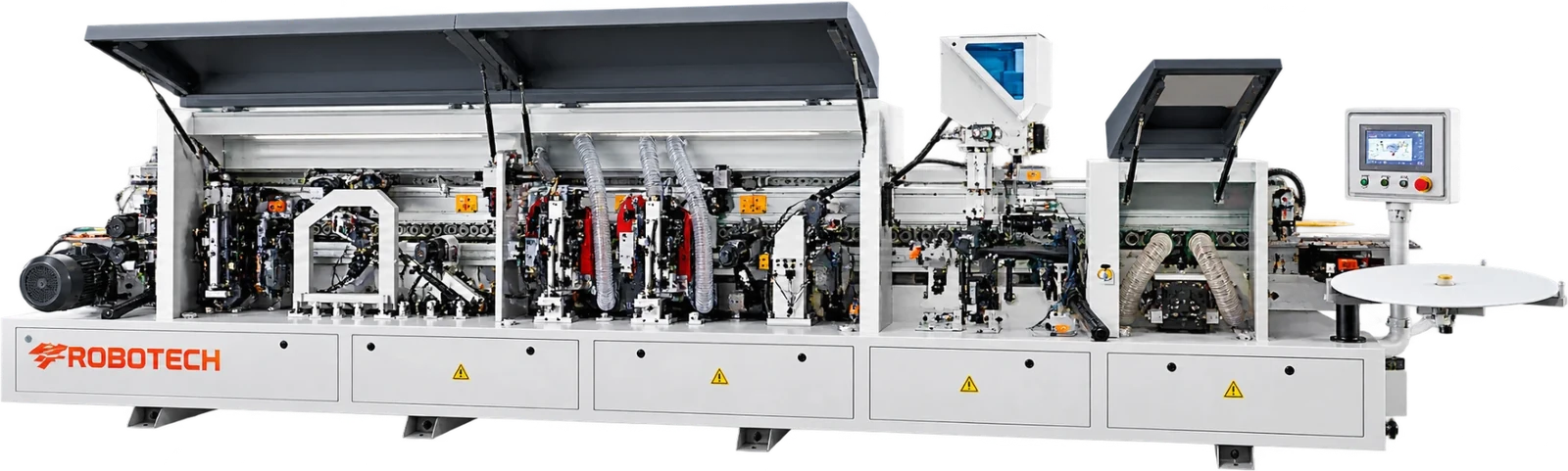
Example: the 4500AT edge banding machine accepts panels from 10 to 45 mm and edging from 0.4 to 3 mm, at a feed speed of 13 to 20 m/min.
Common banding defects and their causes
| Problem | Likely cause | Fix |
|---|---|---|
| Edging comes off easily | Glue temperature too low, or the panel is cold or dusty | Adjust the temperature and clean the panel edge before banding |
| Visible glue line | Too much glue or a panel edge that is not straight | Reduce the amount and check cutting quality before banding |
| Gaps between edging and panel | Insufficient roller pressure | Adjust roller pressure and check the air pressure |
| Uneven trimming | Blunt knives or wrong adjustment | Adjust or replace the knives |
| Whitening on PVC edges | Trimming or scraping pressing too hard | Adjust the scraper and use buffing |
Prepare your workshop before the machine arrives
- Enough length for the machine and for panels going in and out.
- A 3-phase supply with the required capacity.
- An air compressor at the pressure the machine needs (e.g. 0.6 MPa).
- A level, solid floor.
- A clean area away from cutting dust as far as possible.
We review these points with you before delivery, install the machine and train your team on adjustment, operation and daily maintenance. See the details of our edge banding machines, and if you are setting up a workshop from scratch read the guide to setting up a carpentry and kitchen workshop.
The banding stages in an automatic machine
Automatic edge banders pass the panel through a series of units, each doing one stage. Knowing these stages helps you understand the difference between models and what you are paying for:
| Unit | Function | Why it matters |
|---|---|---|
| Pre-milling | Mills the panel edge before gluing | Removes chipping from sawing so the edging bonds with no gaps |
| Gluing and pressing | Applies hot-melt glue and presses the edging with rollers | The heart of the machine and the bond strength |
| End trimming | Trims excess edging at the start and end of the panel | A clean finish to the part |
| Rough and fine trimming | Removes excess edging from top and bottom | An edge flush with the panel face |
| Corner rounding | Rounds the edging corners at the panel ends | A professional look and smooth feel |
| Scraping | Removes fine trimming marks | A smooth surface with no lines |
| Buffing | Polishes the edge and removes glue residue | The finishing touch |
The 486YG, for example, has all these stages and works with panels from 10 to 60 mm and edging from 0.4 to 3 mm at a feed speed of 12 – 20 m/min. The 4500AT works with 10 – 45 mm panels at 13 – 20 m/min, and needs a 380 V 3-phase supply and 0.6 MPa compressed air.
Glue types: EVA or PUR?
Hot-melt glue is what bonds the edging to the panel, and its type affects bond strength and resistance to heat and moisture:
- EVA glue: the most common and cheapest, easy to use and clean, and suited to most interior furniture and wardrobes.
- PUR glue: stronger and much more resistant to water and heat, with a thinner, less visible glue line. Suited to kitchens, bathrooms and premium furniture, but more expensive and needing cleaning and a dedicated unit.
Kitchens and humidity in Saudi Arabia
The kitchen is the hardest place on edges, because steam, water and heat attack the glue line. With the humidity of coastal cities such as Jeddah and Dammam, a weak edge comes off or the panel swells under it quickly. That is why:
- Use moisture-resistant (MR) panels for under-sink cabinets and places exposed to water.
- Band every edge, even back and hidden ones, because moisture gets in through any open edge.
- Use ABS or PVC edging of a suitable thickness for doors and edges exposed to knocks.
- Consider PUR glue for premium kitchens.
How many panels can you band a day?
A feed speed such as 15 m/min means in theory 15 metres of edge per minute, but actual output is lower because of loading and unloading, gaps between panels and changing the edging. A mid-size workshop with one or two workers can band a large amount of edging a day compared with manual banding, which is what makes an automatic edge bander one of the first machines to pay for itself in kitchen and wardrobe factories.
To fit edge banding in with the other machines, see the woodworking workshop machines guide.
Daily care for the edge bander
- Clean hardened glue from the glue pot and pressure rollers before the machine cools.
- Clean the trimming and scraping knives and check their sharpness, because a blunt knife tears the edging instead of trimming it.
- Empty the water trap in the compressed air line and check the pressure.
- Clean dust from the panel infeed sensors so trimming is not early or late.
- Don't leave the glue hot for hours without work, because it burns and loses strength.
These simple habits prevent most banding defects and extend the life of the knives and rollers. For a full maintenance checklist for every machine, read the CNC machine maintenance checklist.
FAQ
Continuous-feed machines like the 4500AT are designed for straight edges, which is what most kitchen, wardrobe and shelf parts need.
Written by the Robotech CNC team
A team specialised in supplying, installing and maintaining CNC and laser machines in Saudi Arabia. On the blog we share what we learn working with workshops and factories.