The Sliding Table Saw: A Buying and Safe Operation Guide for Carpentry Workshops
The sliding table saw is the first machine in most carpentry and kitchen workshops. This guide helps you choose the right length and specifications, and run it safely and accurately.

In this article
- 1.How does a sliding table saw work?
- 2.The scoring blade: the secret of chip-free cutting
- 3.The specifications that decide your choice
- 4.Choosing the saw blade for the material
- 5.Safe operating tips
- 6.The saw's place in the furniture production line
- 7.A practical example: the 6132A specifications
- 8.How to keep the cut accurate
- 9.When to move to a computer beam saw
- 10.Extraction and health
- 11.A cutting plan: save on panels
- 12.Installing the saw and preparing its space
- 13.Materials the saw cuts besides wood
- 14.Summary
- 15.FAQ
Every kitchen or wardrobe workshop starts with cutting panels to size. The accuracy of this step decides the quality of everything after it: edge banding, assembly and fitting doors. That is why the sliding table saw is the foundation of the workshop.
In this guide we explain how the saw works, the specifications that matter, and how to cut without chipping and safely.
How does a sliding table saw work?
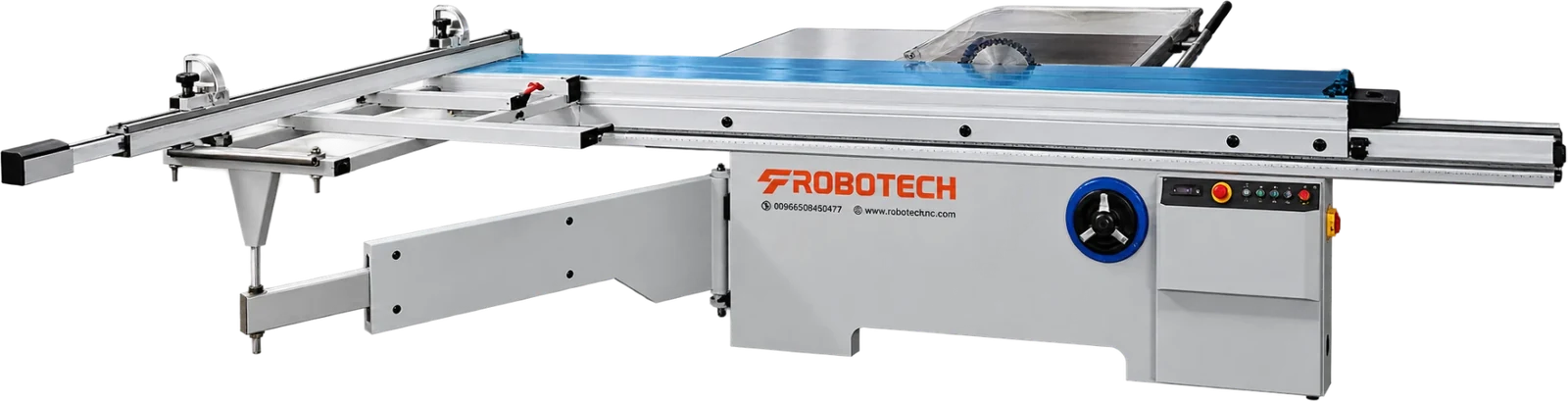
The blade itself is fixed; what moves is a long table that slides alongside it. You place the panel on the table and set it against the fence, then push the table and the panel passes the blade in a perfectly straight line. This differs from a handheld circular saw, where you move the saw over the panel, and gives far higher accuracy, especially with large panels.
The scoring blade: the secret of chip-free cutting
The main blade turns in a direction that makes its teeth exit through the bottom of the panel, which chips the bottom melamine or veneer layer. The solution is the scoring blade: a small blade in front of the main blade, turning in the opposite direction and lightly scoring the underside of the panel, so when the main blade arrives the cut line is clean on both sides.
The specifications that decide your choice
| Specification | What it means for you |
|---|---|
| Sliding table length | The longest panel you can cut in one stroke. A full 244 cm panel needs a table of 3000 mm or longer |
| Max cutting height | The thickest panel or piece of wood you can cut (e.g. 90 mm) |
| Blade tilt | Bevel cuts for angles and joints (e.g. 0 to 45°) |
| Main blade diameter | Linked to cutting height |
| Scoring blade and its motor | Essential for melamine and veneer |
| Main motor power | Decides cutting capacity in hardwood and large thicknesses |
Example: the 6132A sliding table saw comes with a 3000, 3200 or 3800 mm table, 90 mm cutting height, 0 to 45° tilt, and a 5.5 kW main motor with a scoring blade.
Choosing the saw blade for the material
- Melamine-faced panels: a blade with many teeth for a smooth cut, together with the scoring blade.
- Natural wood (rip cuts): a blade with fewer teeth that clears chips quickly.
- Acrylic and PVC: a blade made for plastics so the edge does not melt or crack.
- Aluminium composite: a blade made for non-ferrous metals.
A sharp, suitable blade reduces the load on the motor and gives a cleaner cut, and a worn blade is one of the most common causes of rough cuts and burning.
Safe operating tips
- Always use the top blade guard.
- Never cut small parts by hand close to the blade; use a push stick.
- Raise the blade only slightly above the panel thickness.
- Connect the saw to a dust extractor; dust harms health and reduces visibility.
- Disconnect the power before changing the blade or making adjustments.
- Wear safety glasses and hearing protection.
The saw's place in the furniture production line
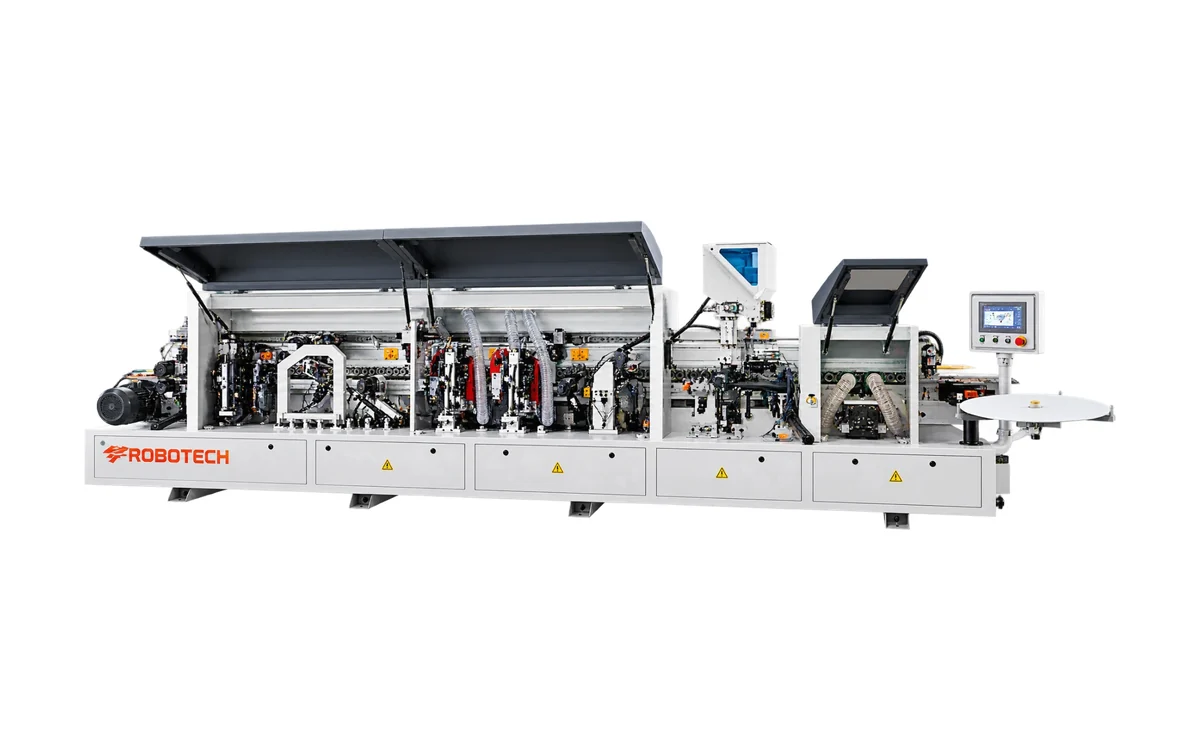
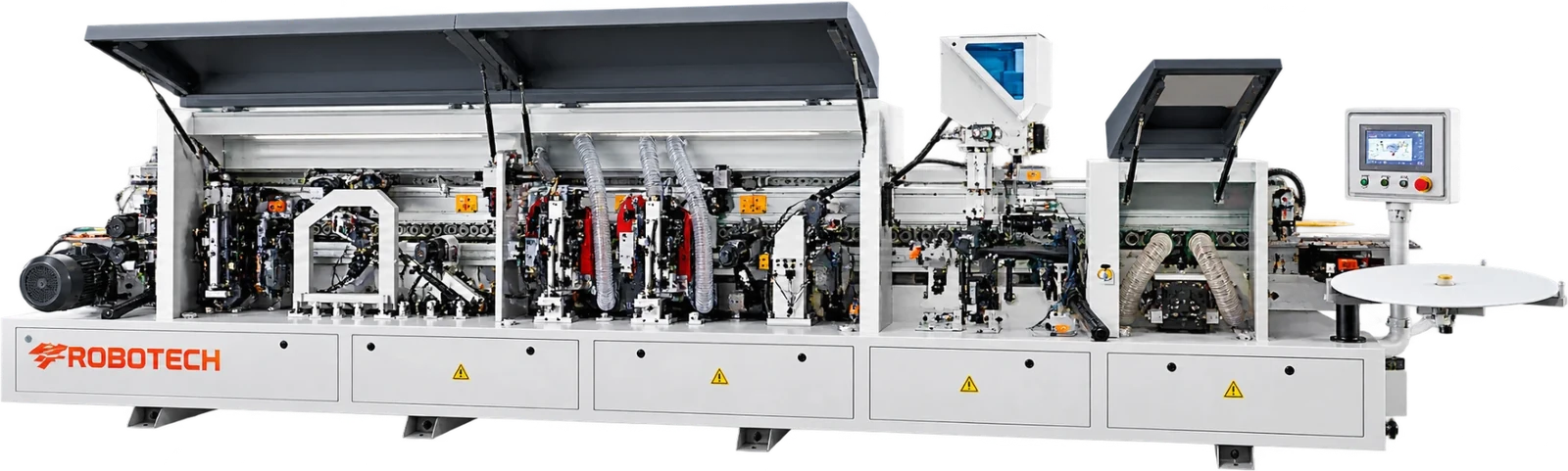
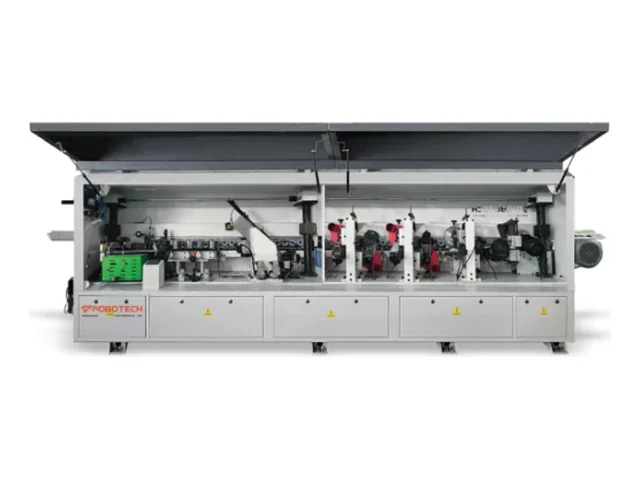
In a kitchen and wardrobe workshop, the saw is the first step, followed by the edge banding machine, whose quality depends on a clean, straight cut edge. If you are setting up a new workshop, read the guide to setting up a carpentry and kitchen workshop.
A practical example: the 6132A specifications
To understand the specifications in practice, here are the specifications of the 6132A sliding table saw and what they mean for your work:
| Specification | Value | What it means for you |
|---|---|---|
| Sliding table length | 3000 / 3200 / 3800 mm | 3200 is enough for a standard 2440 mm panel with margin, and 3800 for longer panels |
| Max cutting height | 90 mm | Cuts single and thick panels and natural wood |
| Blade tilt | 0 – 45° | Bevel cuts for frames and edges |
| Main blade | 300 mm with a 5.5 kW motor | Steady cutting power without slowing in tough panels |
| Scoring blade | 120 mm | Prevents chipping on the underside of melamine |
How to keep the cut accurate
Saw accuracy is the basis of accuracy for all the furniture. If the cut is not exactly square at 90°, wardrobes come out crooked and doors do not close properly. These are the key points:
- Check the angle regularly: cut a panel, turn it over and measure both diagonals; if they differ, the angle needs adjusting.
- Keep the sliding table rail clean: chips on the rail make the motion uneven and affect straightness.
- Align the scoring blade: it must be exactly on the main blade's line, or a small step appears on the edge.
- Blade sharpness: a blunt blade burns the edge, chips melamine and strains the motor.
- The measuring scale: make sure the scale and stops are set to the true measurement.
When to move to a computer beam saw
A sliding table saw is excellent for workshops and small and mid-size factories, but as production grows you notice the saw has become the bottleneck: the worker cuts panel by panel, measuring is manual, and errors increase with fatigue.
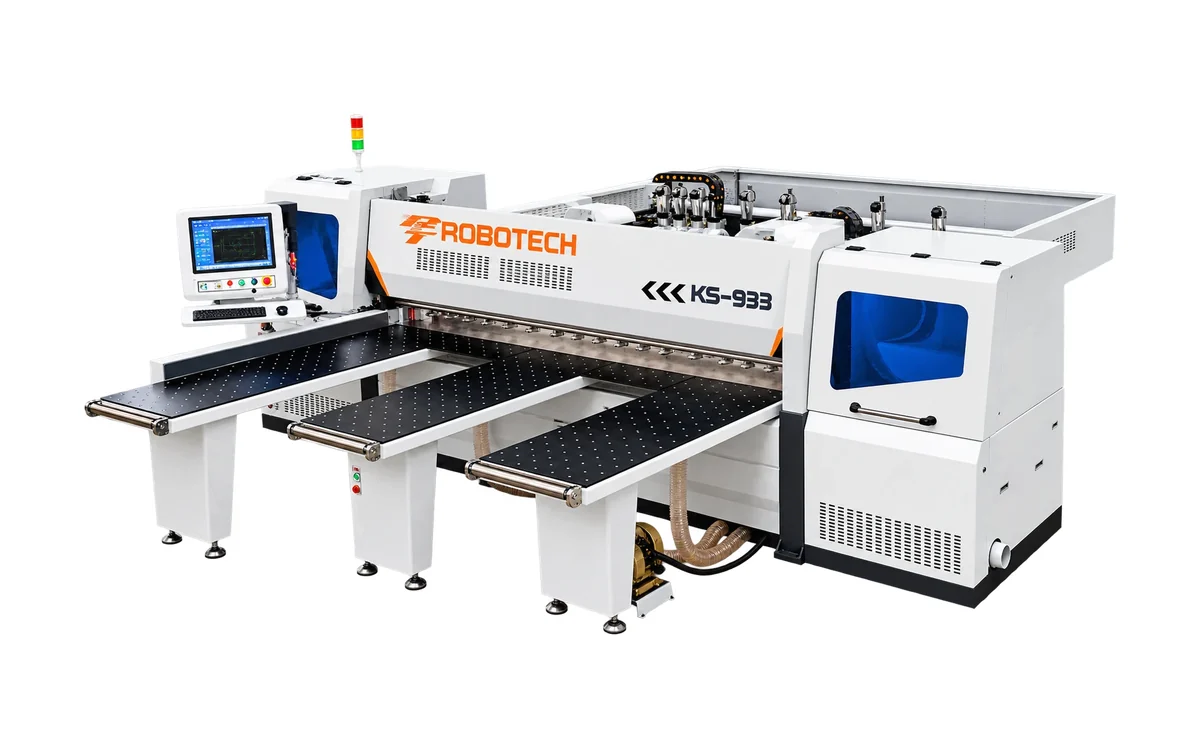
This is where the KS933 computer beam saw comes in: it cuts a stack of panels at once with a 3200 mm cutting length and up to 120 mm height, and the machine pulls the panels with a servo drive and cuts them to the programmed sizes. The result is much higher output and fewer errors, and it suits kitchen and furniture factories producing in volume.
| Sliding table saw | Computer beam saw | |
|---|---|---|
| Output | Panel by panel | A stack of panels at once |
| Measuring | Manual with the scale | Programmed from the computer |
| Space | Smaller | Larger |
| Suited to | Workshops and varied production | Factories and high volumes |
Extraction and health
MDF and particle board dust is very fine and harms the lungs over time, and builds up on motors and rails. Connect the saw to an extractor with enough capacity, from the extraction port under the blade and from the top blade guard if there is one, and clean the area daily.
A cutting plan: save on panels
The biggest expense in a furniture workshop is the panels themselves, and any cutting waste comes out of your profit. Before you start cutting, arrange the parts on the panel to use as much of it as possible:
- Collect all the parts for the order (or several orders) before cutting, and sort them by colour and thickness.
- Use simple nesting software that arranges parts on the panel and gives you a cutting plan.
- Start with the large parts, and use offcuts for small parts such as shelves and drawers.
- Write each part's number and position in the wardrobe on it so it does not get lost at assembly.
- Keep useful offcuts sorted by colour for future orders.
A good cutting plan can save a clear share of your panels every month, a continuous saving at no extra cost.
Installing the saw and preparing its space
- Floor: it must be level and strong, because any slope affects the straightness of the sliding table.
- Space: enough distance in front of and behind the saw for the full sliding table length, and space at the side for the panel width.
- Power: a 380 V 3-phase line with a breaker suited to the 5.5 kW motor and the scoring motor.
- Extraction: the extractor and its ducting close to the saw.
- Lighting: strong lighting over the cutting area helps read the scale accurately and reduces errors.
Materials the saw cuts besides wood
A sliding table saw is not limited to MDF and particle board. With the right blade it cuts PVC, acrylic and polycarbonate sheet, natural wood and blockboard, and thin cladding panels for some uses. Each material has a blade with a different number and shape of teeth, so don't use a wood blade on acrylic, because it chips or melts it. This flexibility makes the saw one of the most used machines in décor and fit-out workshops, not only in furniture factories.
Summary
The sliding table saw is the foundation of any furniture workshop, and its accuracy decides the quality of every stage after it. Choose the table length for your panels, don't compromise on the scoring blade and good blades, and keep up calibration and cleaning. And when the saw becomes the production bottleneck, consider a computer beam saw.
FAQ
On a sliding table saw the table and panel move past a fixed blade in a straight line, giving much higher accuracy with large panels, plus a scoring blade that prevents chipping.
Written by the Robotech CNC team
A team specialised in supplying, installing and maintaining CNC and laser machines in Saudi Arabia. On the blog we share what we learn working with workshops and factories.